
The Dunbar lost
20 August 1857, Sydney Heads
Royal Charter lost
26 October 1859, Anglesey, Wales
Partners
Bournemouth University & ANMM
Research theme
The archaeology of coming to Australia
Rushin’
A gold rush told through two shipwrecks
In light of the 2018 commemorations of The Dunbar’s loss, Silentworld Foundation teamed up with Bournemouth University, UK, and the Australian National Maritime Museum in a collaborative project that takes a broader view of the period through the lens of two shipwrecks.
The Australian gold rush of the 1850s was arguably one of the greatest economic and social events in Australia’s colonial history. The ‘Rush’ brought a huge influx of people to visit or migrate permanently to the Australian colonies.
Emigrants brought new political ideas to the young colonies, leading to events that would ultimately shape the nation, such as the end of convict transportation to the eastern colonies in 1853.
The artefact collections relating to the wrecks of The Dunbar and Royal Charter are ‘bookends’ to this economic and social event: The Dunbar carried people and cargo out to the diggings, while Royal Charter represents the return voyage to Great Britain. The loss of both vessels had a massive impact on their communities, at the time and for years afterwards.
Bookends
The two ships

The Dunbar new East Indiaman, hand-coloured wood engraving published London 1853. ANMM Collection 00000957
Outbound to the diggings
The Dunbar
- Type
- Blackwall frigate
- Tonnage
- 1,321 (registered)
- Rig
- Ship
- Length
- 61.5m (201′ 9″)
- Beam
- 10.66m (35′)
- Depth
- 6.9m (22′ 7″)
- Construction
- Oak and teak, reinforced with iron knees, iron breast- and stern-hooks and iron riders; copper-sheathed and fastened

Liverpool and Australian Navigation Company clipper ship Royal Charter, hand-coloured wood engraving published London 1855. ANMM Collection 00001144
Homeward with the gold
Royal Charter
- Type
- Auxiliary steam clipper
- Tonnage
- 2,719
- Length
- 72m (236′)
- Beam
- 12m (39′)
- Depth of hold
- 7.0m (23′)
- Propulsion
- Single direct-acting steam trunk engine of 200 nominal horsepower, single iron propeller
20 August 1857
The Dunbar
On 31 May 1857, The Dunbar departed Plymouth, England, and arrived off the coast of Sydney on the evening of 20 August, 81 days later. The day had been stormy, and that evening a gale rose with squalls that obscured the loom of Macquarie Light, on the sea cliffs 2.4 kilometres south of the entrance to Port Jackson.
Shortly before midnight, Captain Green calculated the ship was six miles (9.7 kilometres) north-east of the entrance to Sydney Harbour, and ordered a blue light burnt to summon a pilot. He then ordered the vessel to approach the Heads, keeping Macquarie Light on the port bow.
Shortly afterwards, the Second Mate on the forepeak cried out ‘Breakers ahead!’ and Macquarie Light loomed above the ship. Green, confused by rain squalls and currents, ordered the ship to starboard, which catastrophically drove The Dunbar into 60m-high sea cliffs.
Every passenger – man, woman and child – and all but one of the ship’s crew died in the wild seas that crashed over the wrecked vessel and into the cliffs.
25–26 October 1859
Royal Charter
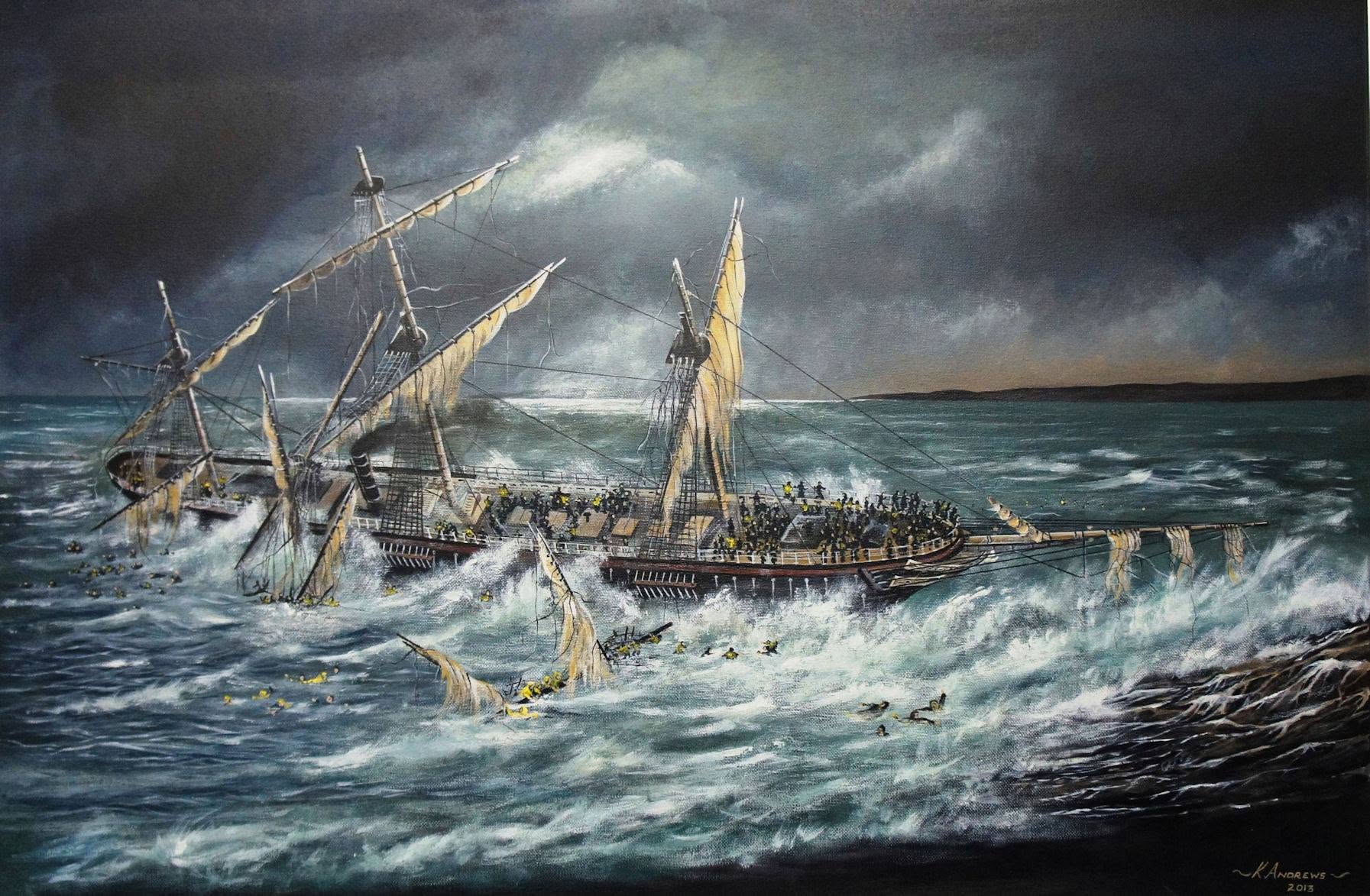
In October 1859 the clipper was returning to Liverpool from Melbourne with approximately 320 passengers, a crew of 112 and a handful of company employees when it met a Force 10 storm, now known as the Royal Charter Storm, off Anglesey, Wales. During the night of 25–26 October the wind changed direction and rose to a Force 12 hurricane, driving the ship toward the coast.
Captain Taylor anchored offshore, cut down the masts to reduce top-hamper and tried to ride out the storm under engine. Despite these efforts, all anchor cables parted and Royal Charter was driven ashore at Porth Alerth, where it quickly broke up. A crewman managed to swim ashore, which enabled the rescue of 21 male passengers and 18 male crew. Most of those aboard, over 450 people, drowned.
Royal Charter carried at least £322,000 of gold in its strong room, along with gold dust, nuggets and Sydney Mint sovereigns carried by miners returning from ‘the diggings’. Speculation and accusations of theft continue to this day.
The project
So, what will this project do?
The two wreck sites and their artefact collections can contribute significantly to ongoing research into ‘The Archaeology of Coming to Australia’. Between 1788 and 1900 there were four main ways that Europeans came to Australia:
- as a convict (1788–1868)
- as a government migrant (1822–1845)
- as a gold miner (1851–1860)
- as a bounty immigrant (1860–1899)
Arguably, the gold rushes had the most dramatic and long-lasting impact of these four phases.
Through the case study of The Dunbar and Royal Charter, the project sets out to conduct the first comprehensive study of Australian gold rush shipwrecks, their material culture and their impact, by locating and assessing the extensive collections relating to the two vessels held in public and private hands in Australia and the UK. The research will also provide evocative material for a physical or virtual exhibition exploring this story, which spans halfway around the globe.
Two revolutionary ship types
The vessels are very good examples of significant ship design and construction: one a Blackwall frigate, the other an auxiliary steam clipper. These two types revolutionised passenger travel in the mid-19th century, allowing people, goods, news, technologies and ideas to flow quickly between the Australian colonies and Europe. Comparing each vessel’s structural remains could reveal new insights into how the design, construction and outfitting of gold rush ships evolved.