
Click any image to view in full resolution
Click any image to view in full resolution
Description:
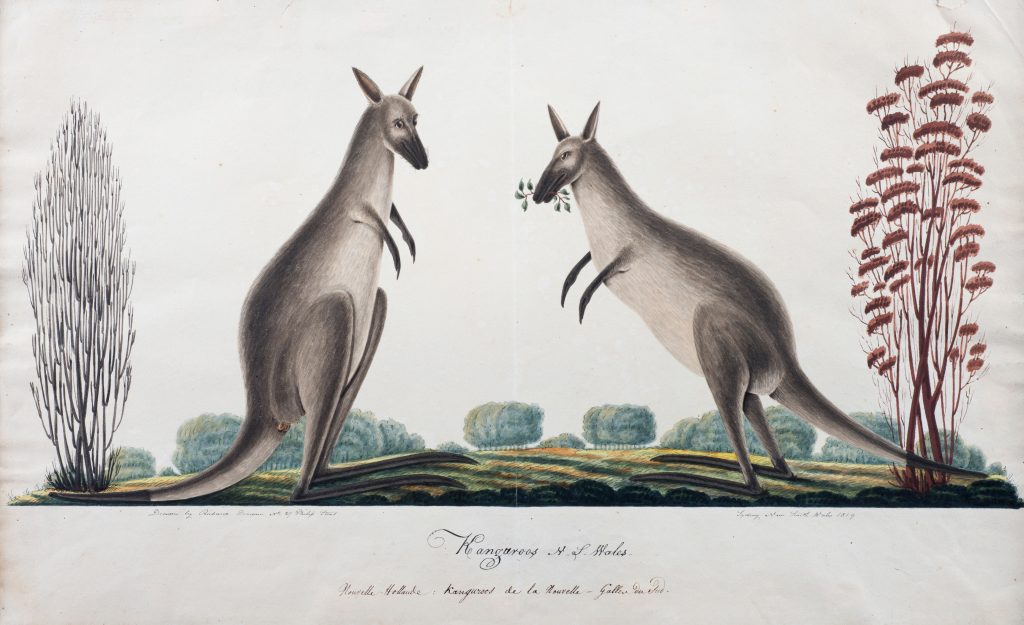
Browne, Richard (1776-1824) Deux kangourous Gouache watercolour on paper. 29.5cm x 48cm. 27 Philip St, Sydney 1813. Richard Browne was convicted in Dublin in February 180 and arrived at Sydney in July 1811 in the Providence. In October he was sent to Newcastle for committing a second offence and remained there...
Read moreBrowne, Richard (1776-1824)
Deux kangourous
Gouache watercolour on paper. 29.5cm x 48cm. 27 Philip St, Sydney 1813.
Richard Browne was convicted in Dublin in February 180 and arrived at Sydney in July 1811 in the Providence. In October he was sent to Newcastle for committing a second offence and remained there until his emancipation in 1817. At some time during this period he married, or formed a liaison with, a convict named Sarah Coates who had been transported in the Wanstead in 1814. Sarah had been sent to Newcastle for a year in July, afterwards presumably remaining as Browne’s wife.
As an artist, Browne’s early works were of natural history subjects; later he turned to figurative work, particularly of indigenous Australians. Some of his earliest colonial drawings are the illustrations in a manuscript of the natural history of Australia, prepared in 1813 for Lieutenant Thomas Skottowe, then commandant at the Newcastle secondary penal station where Browne served most of his sentence. The artist may have been related to the Irish natural historian Dr Patrick Browne as the expert way in which the birds, reptiles, fish and butterflies are delineated in the Skottowe manuscript suggests some professional association with a natural history circle. Browne’s animal studies, perhaps because of the strangeness of New Holland mammalia, are less expert, while his early Aboriginal figure subjects are ill-formed and amateurish compared with the natural history subjects.
Browne’s somewhat crude watercolour of two kangaroos is signed by him and annotated with his address in Philip St, Sydney. The painting was purchased by a crew member of Freycinet’s ship L’URANIE who added the underlying French legend during the ship’s visit to Sydney in 1819.
Read less