
Project · Robe, South Australia
Koning Willem de Tweede
An 800-ton Dutch merchant ship lost in a storm in Guichen Bay in 1857, and most likely found in March 2025 after a three-year search.
Koning Willem de Tweede at Batavia, painting by Jacob Spin, 1842 · Image: Rotterdam Maritime Museum
Vessel
800-ton Dutch merchant sailing ship
Lost
30 June 1857, Guichen Bay, Robe
Search began
April 2022
Site identified
March 2025
Background
A brief history
Koning Willem de Tweede, an 800-ton Dutch merchant sailing ship, was lost on 30th June 1857 in Guichen Bay near Robe, South Australia. The ship was transporting Chinese miners to the port of Robe, where they would begin their overland journey to the goldfields in Victoria. Silentworld Foundation and the Australian National Maritime Museum began investigations into the whereabouts of the wreck in April 2022.
In addition to the on- and in-water surveys with magnetometer and metal detectors, we have conducted community conservation workshops and investigated shipwreck artefacts that are held within the community.
In March 2025, in conjunction with the Australian National Maritime Museum, Flinders University and the Department for Environment and Water, we most likely identified the wreck of Koning Willem de Tweede.
30 June 1857
Wrecking event
Koning Willem de Tweede was transporting Chinese miners to the port of Robe, where they would begin an overland journey to the goldfields. Luckily, all 400 Chinese passengers had offloaded from the ship on the 15th of June, while the ship remained anchored in Guichen Bay waiting out inclement weather. However, on the 30th of June a severe storm struck.
Reports vary as to whether or not the windlass was wrenched from the deck, but eventually Captain Hindrik Remmelt Giezen ordered the ship to run aground on Long Beach. The ship grounded on sand close in to shore, but perhaps due to the storm’s intensity and wave action, it broke up very quickly. In total 15 of the crew of 25 were lost as a lifeboat tipped over.
Captain Giezen survived, and was eventually rescued by way of a barrel tied to a rope, the other end of which was thrown to rescuers on shore who towed him through the surf.
Fieldwork
Archaeological surveys
Accounts from 1857 state that the ship wrecked four miles from the town’s centre at Long Beach. The research team drew a straight line from the Customs House at Robe, found the point four miles along, and used this as the basis of the search area.
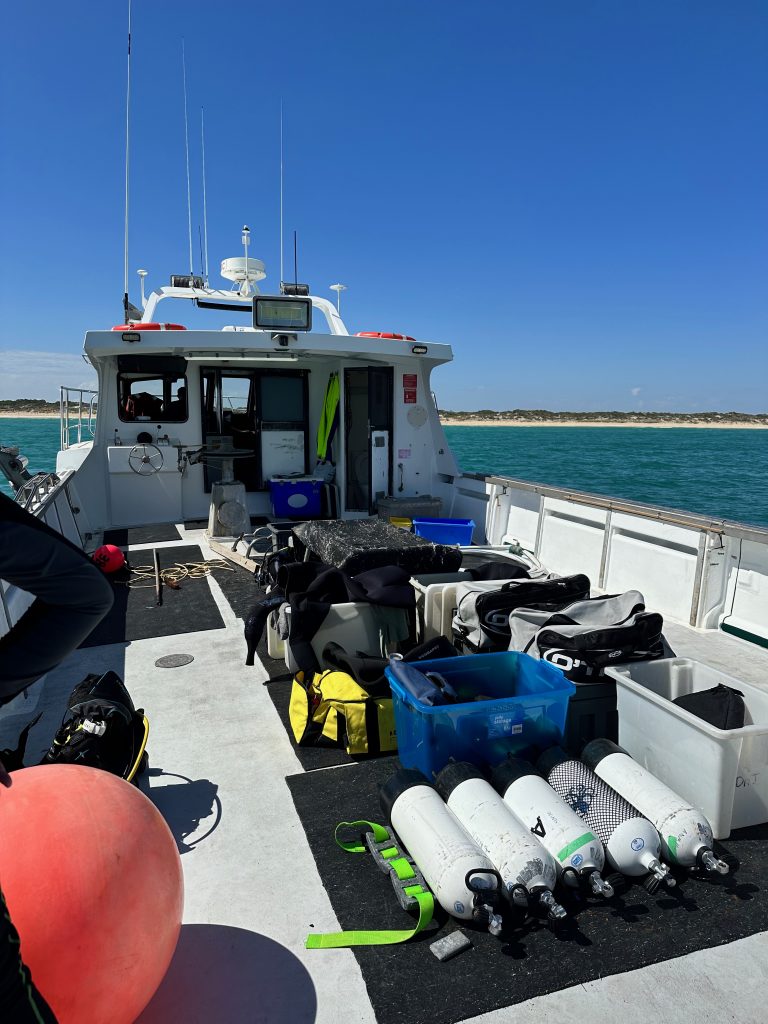
Two attempts were made to find the wreck using divers, metal detectors and a magnetometer, before the third and ultimately successful attempt. On-shore surveys were also undertaken using metal detectors.
In March 2025, Silentworld Foundation’s Heather Berry and the Australian National Maritime Museum’s Dr James Hunter teamed up with Mark Polzer from the Department for Environment and Water, Ruud Stelten and Justine Buchler from Flinders University, and Kevin Jones, formerly Director of the South Australian Maritime Museum, to search for the shipwreck.
A magnetometer operated by Justine Buchler was towed behind the boat, and she identified points of interest as indicated by the instrument. The team returned to the most promising point and dived. James Hunter, Mark Polzer and Ruud Stelten immediately found a large iron object proud of the seabed, which Ruud Stelten photographed. Poor visibility and at times intense surge made the site difficult to explore and map, so further examination was required.

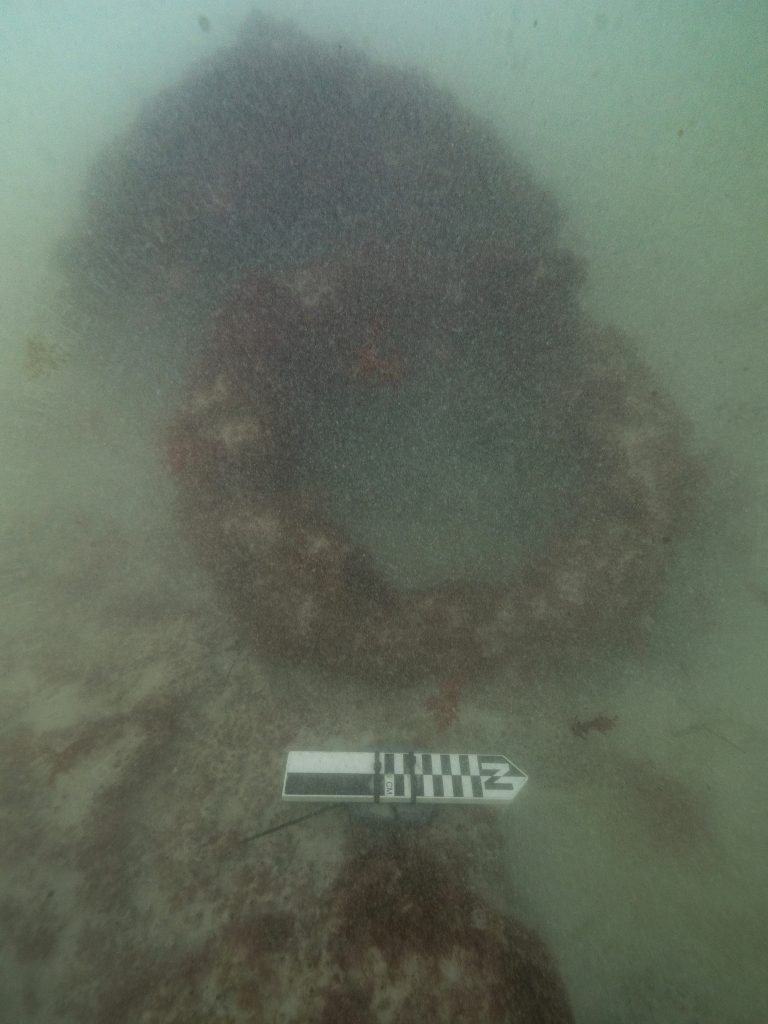
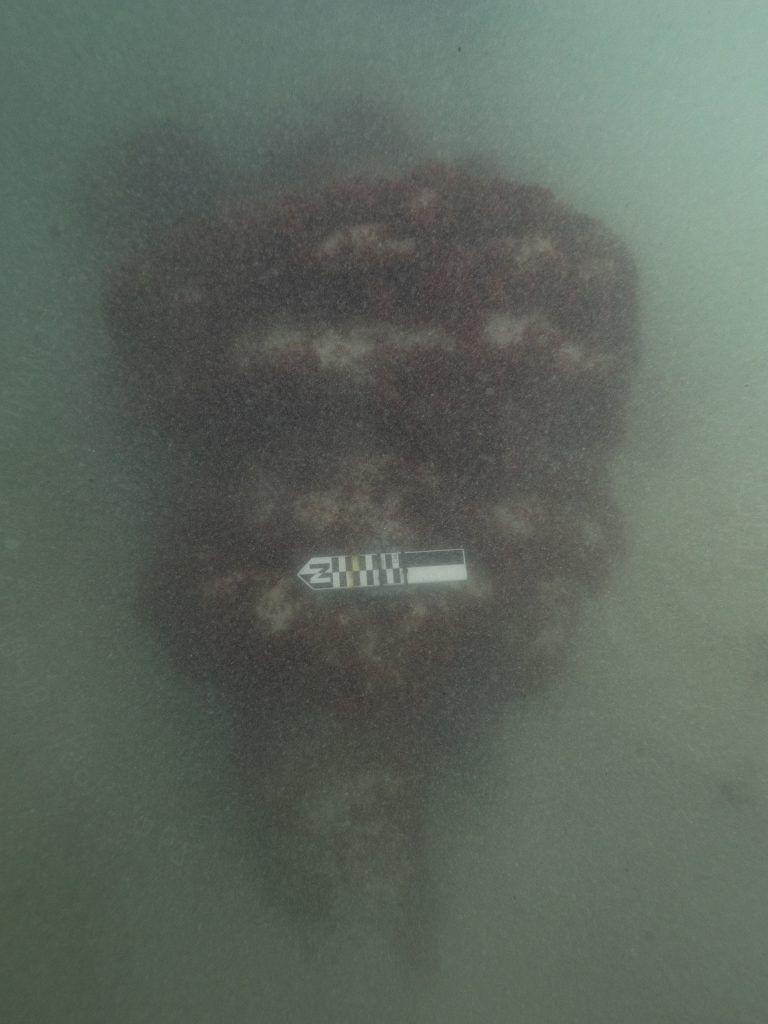
Iron windlass components discovered during the search for Koning Willem de Tweede’s shipwreck site. Images: Ruud Stelten
March 2025
The find
Subsequent dives involved further investigation of the object of interest, which appears to be a windlass. While assisting James Hunter with measurements of the object so that it could be drawn topside, Heather Berry caught a glimpse of a timber, only just visible through the sand. Probing of the area suggested there may be more timber under the surface.
After three days of diving the probable windlass had been photographed and measured thoroughly, and visibility and surge made it unwise to continue diving.
Based on the location of the windlass and the pattern of anomalies detected by the magnetometer, the team is confident this is the site of the wreck of Koning Willem de Tweede.
Robe community
Working with the community
Beginning in 2022, the team from Silentworld Foundation and the Australian National Maritime Museum have not only searched for Koning Willem de Tweede, but also engaged with community members, many of whom have found shipwreck material washed up on shore. These finds may be from Koning Willem de Tweede, but may also be from several other ships known to have wrecked in Guichen Bay.
The examination of these artefacts, and recommendations made by Silentworld Foundation’s conservator Heather Berry, inspired a conservation booklet for communities.
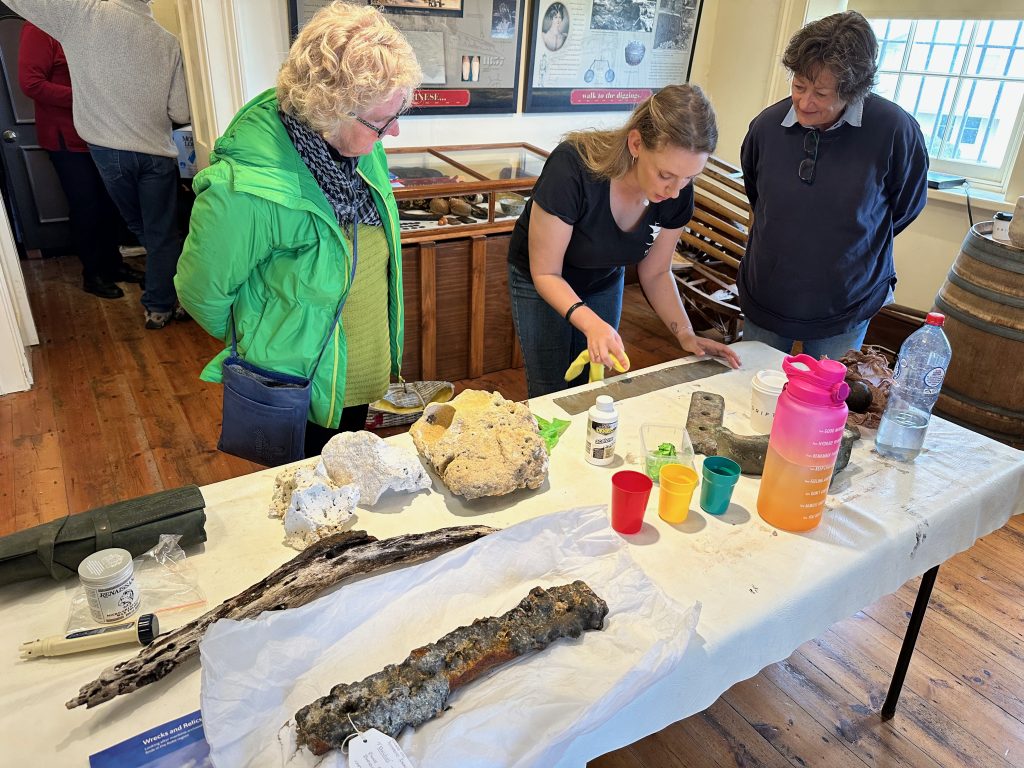
Heather Berry examining and providing first aid treatment to artefacts provided by community members. Image: James Hunter
Community conservation workshops
Three community workshops have been held, hosted at the Customs House operated by the National Trust of South Australia Robe Branch.
While James Hunter helped community members identify the ceramic sherds, timber and iron concretions they brought in, Heather Berry provided first aid conservation and storage recommendations.
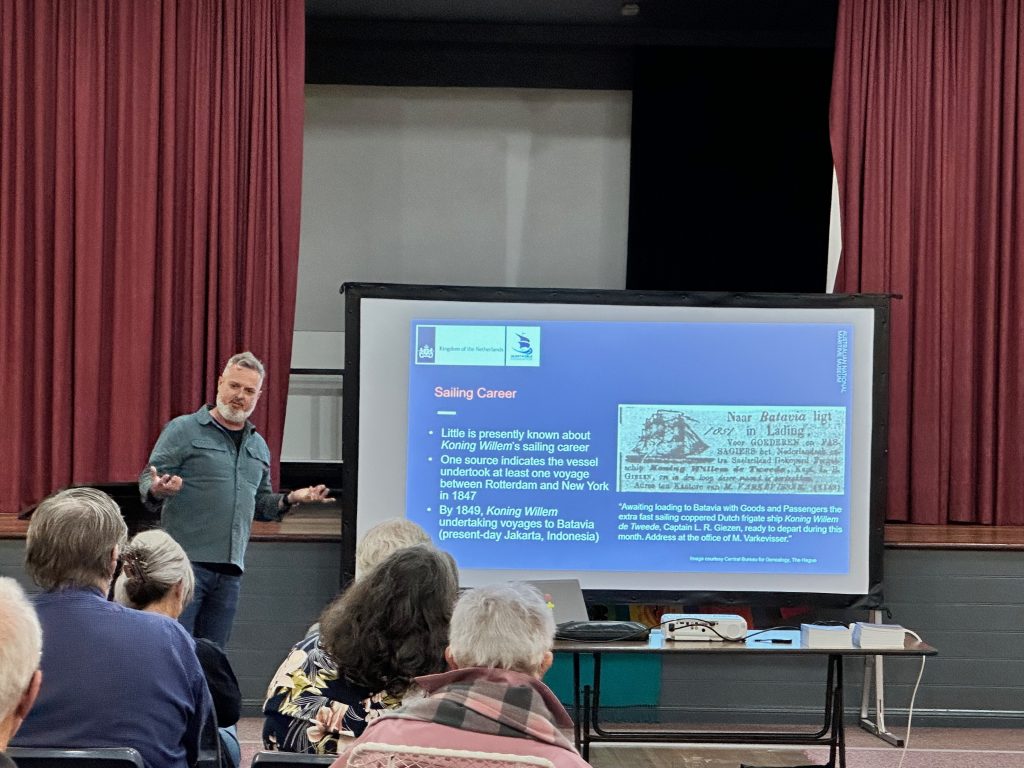
James Hunter delivering a talk on the history of Koning Willem de Tweede to community members. Image: Heather Berry
Community events
Although many in Robe know Koning Willem de Tweede’s story well, keeping the community updated was always important to the team. Most visits to Robe included community information nights, where all were welcome to hear about what the team was discovering (or not) under the waves and in the archives.
These events were generously hosted by the National Trust of South Australia Robe Branch with the Robe History Group. Audiences sometimes included descendants of the surviving crew, making for lively discussions and even family reunions.
Acknowledgement. The Koning Willem de Tweede Shipwreck Project has been assisted by the Dutch Ministry of Foreign Affairs, through the Embassy of the Kingdom of the Netherlands, Australia, and the Cultural Heritage Agency of the Netherlands.
More projects